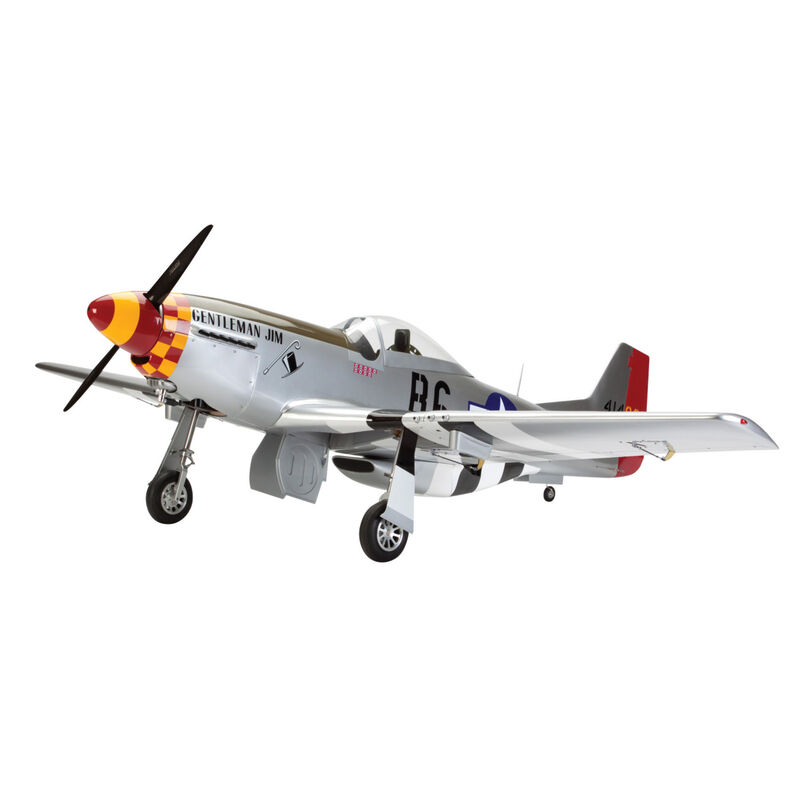
Interview with Mike McConville about the Original Hangar 9 P-51 Mustang PTS
 |
Hangar 9´s aircraft design leader Mike McConville |
Why did you decide to develop a P-51 as a trainer?
A: As long as I have been involved with RC, which is pretty much since
I was a very small child, I don't remember anyone who aspired to get into
the hobby and WANTED to start with a high wing "Trainer." Most
wanted to start with a P-51, but settled for the trainer when they learned
that it was impossible to learn to fly on a P-51.
We started with a blank sheet of paper and the goal of finally giving
the RC newcomer what they really want.
What were some challenges in developing it?
A: Warbirds have been traditionally difficult to takeoff, fly and land.
Making a model that captures the looks of the P-51 Mustang, yet flies
and ground handles well was quite a challenge. We did a lot of experimentation — trying
and changing things to finally arrive on the end product.
Are there any concerns that the market won't accept the concept?
A: Yes, it goes against the conventional way of thinking. Of course, newcomers
to RC will be thrilled, but convincing the flight instructors and hobby
store owners is a challenge. However, it's a challenge we can take on,
because quite frankly, it works very well. The best way to convince anyone
how amazing it is as a trainer is for them to try it.
How is this different than other trainers?
A: Short answer, it's a P-51 Mustang, and it's truly revolutionary.
PTS is essentially a series of features
on a model that make a subject that is traditionally attractive but not
a good trainer work very well as a trainer. Then, on top of that, the
features can be changed or removed so the model's capabilities grow with
the student's skills. In the end, the model becomes an aerobatic sport
model that the student can continue to have fun with long after all flight
training is complete.
I believe that this model will forever change how trainers are perceived
and how new modelers get started in RC.
Is this really something that beginners can learn on or is it more
advanced?
A: Absolutely, it's something a beginner can learn on. In the basic mode,
as it comes out of the box, it is as slow as a traditional trainer, very
stable and is virtually impossible to tip stall or get into a spin. Although
one of the challenges we had was making a tail dragger ground handle ok,
we ended up far surpassing that goal. The P-51 actually ground handles
better than any high wing tricycle gear equipped model I've flown. Crosswinds
won't tip it over like a traditional trainer. Ground steering is smooth
and easy to do. Takeoff runs just need full throttle, an occasional bump
of rudder to steer and a bump of up elevator when it's up to flying speed.
It won't nose over, and it stays straight as an arrow on the runway.
In fact, after we had the model developed, we put several beginners on
the sticks. Several made their very first takeoffs and landings on the
P-51 PTS.
What if someone already has a trainer? Why would they want this one?
A: If they have already mastered some basic flying skills, they can
keep on progressing. The P-51 will take them right up and into aerobatics,
including inverted flight, snap rolls and more.
What if someone is an experienced pilot? Why would this appeal to them?
A: Experienced pilots would also enjoy this model because once all of
the training features are removed, it's a great sport aerobatic P-51.
Even a very seasoned modeler who wants a good-looking .46-size warbird
will be interested in this one.
During the development of this model, I took one of our prototypes to
a local field and passed the transmitter around to everyone — beginners
and experienced guys alike.
How easy is it to get the plane in the air?
A: Very easy. Probably 15 to 20 minutes to assemble it. It is the easiest
to assemble of all of the RTF models we've done.
Can this plane be upgraded?
A: Yes. During training, the flaps have two preset positions. They are
lowered 22 degrees for basic training and neutralized as step 3 of the
progression. Both positions are preset. After a student graduates, they
can buy a 6th servo and make the flaps move. Since the P-51 comes with
a JR 421 transmitter, the 5th channel is already there.
Is it durable? What if someone crashes it? Can they get parts?
A: Absolutely. It is engineered to stand up to the typical knocks a trainer
will see as a student learns to fly. If parts do get damaged beyond repair,
no problem. We carry a full stock of all replacement parts. And the plug-in two-piece
wing makes it easy to transport as well.
|